By Daniela Morich and Gian Luca Burci
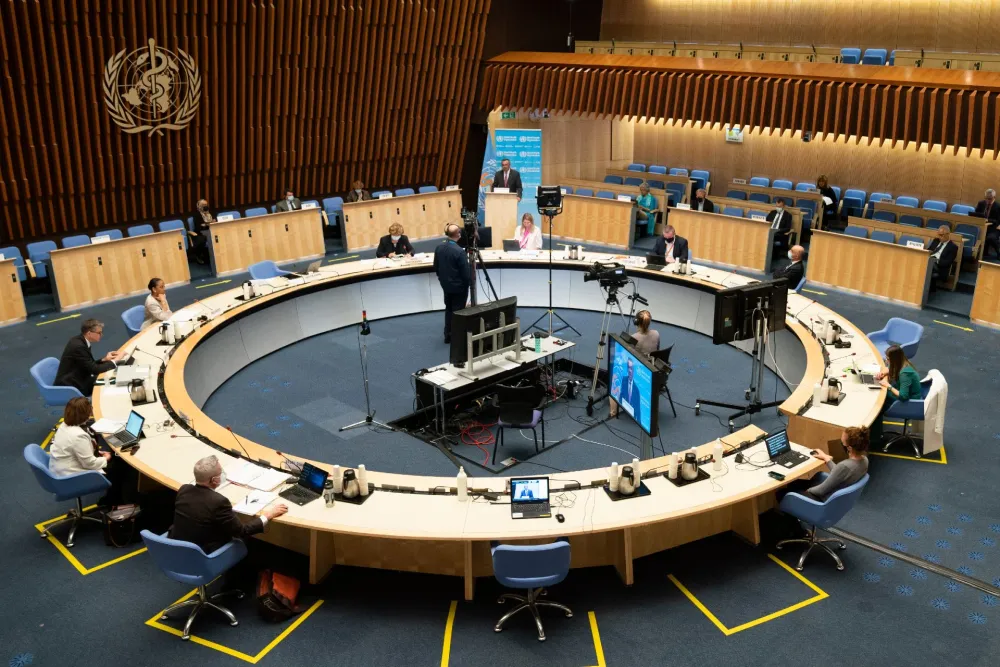
On 20 May 2025, after more than three years of negotiations, the World Health Assembly (WHA), the highest decision-making body of the World Health Organization (WHO), adopted the WHO Pandemic Agreement (PA). Launched during the COVID-19 pandemic to establish international rules for more effective responses to global health threats, the PA negotiations ran in parallel with talks to amend the International Health Regulations (IHR), the only legally binding instrument currently governing international responses to disease outbreaks.
Work on the IHR was completed in May 2024, as initially planned, with the adoption of a substantial set of amendments. WHO Member States, however, required an additional year to finalise the broader, more ambitious, and politically sensitive PA – a remarkable achievement considering an international context dominated by armed conflicts, climate disasters, and growing disenchantment with multilateralism. Compounding these pressures was the announced U.S. withdrawal from WHO in January 2025, which cut billions from WHO’s budget and left the organisation scrambling to absorb the shock. The treaty is not yet open for signatures as negotiations continue on the highly disputed Pathogen Access and Benefit Sharing Annex.
One Step at a Time: Adoption, but No Completion
The PA presents a fundamental challenge: it has a broad and ambitious scope addressing prevention, surveillance, preparedness, financing, and response in one document, but its objective is to prevent and respond to pandemics, a narrowly defined and hopefully rare event.
It will require leadership and strategic vision to avert the “prevention paradox” whereby decision-makers hesitate to invest in preventing unpredictable and unlikely risks, despite the potentially catastrophic consequences if those risks materialise.
To achieve this, many of its provisions are not about emergency measures triggered by a pandemic but require systemic and potentially demanding changes to strengthen preparedness and prevention. It will require leadership and strategic vision to avert the “prevention paradox” whereby decision-makers hesitate to invest in preventing unpredictable and unlikely risks, despite the potentially catastrophic consequences if those risks materialise.
The agreement is also supposed to work in synergy with the amended IHR as a single coordinated legal regime to bolster global health security. Pandemic emergencies would be declared by the WHO Director-General under the IHR, but such a declaration would automatically trigger legal obligations under the agreement, a separate legally binding instrument.
Despite the many qualifications in most of its obligations, the agreement breaks new ground in several respects, and its achievements should not be underestimated. For the first time, for example, a multilateral treaty enshrines the “One Health” approach. It aims to balance human and animal health with environmental protection, while prioritising integrated surveillance, prevention of zoonotic spillovers, and intersectoral planning. Resistance from developing countries concerned about unsustainable obligations and obstacles to agricultural trade led to a broad compromise text, but much can be built on it in the future, including as a catalyst for the work of the Quadripartite, a coalition of FAO, UNEP, WHO, and WOAH to coordinate international work on One Health.
The treaty contains the first-ever international obligations to strengthen pharmaceutical research and development (R&D), particularly in developing countries, and to promote sharing and access to research and evidence. This marks the culmination of 20 years of efforts within the WHO to achieve a modicum of international regulation of R&D.
The treaty also addresses the issue of technology transfer for pandemic-related health products, a subject of contention until the final hours of the negotiations. Some countries insisted that such transfer should occur only on a voluntary basis, with others arguing that governments should have the right to compel access to know-how in the absence of voluntary agreements.
Finally, negotiators agreed on a provision on technology transfer “as mutually agreed” to achieve a more equitable geographical distribution of pharmaceutical manufacturing and reduce the risk of scarcity during pandemics, especially regarding vaccines. This compromise was considered a victory for the pharmaceutical industry over the risk of compulsory measures, besides the flexibilities already foreseen in the WTO’s TRIPS Agreement.
Even though the PA’s adoption is certainly a much-needed victory for multilateral diplomacy, it revealed deep divisions and mistrust between the Global North and the Global South, with inflexible negotiating positions partly fed by resentment at the hoarding of COVID-19 vaccines by developed countries.
Even though the PA’s adoption is certainly a much-needed victory for multilateral diplomacy, it revealed deep divisions and mistrust between the Global North and the Global South, with inflexible negotiating positions partly fed by resentment at the hoarding of COVID-19 vaccines by developed countries. These differences will probably reverberate in the PABS Annex negotiations and may affect the implementation of the PA in the long term.
The Missing Piece: the Annex on PABS
A long-standing challenge in managing infectious disease outbreaks is how to fairly, quickly, and reliably share pathogens—including their genetic sequences—and the benefits derived from them, a process known as pathogen access and benefit sharing (PABS). PABS is crucial during health emergencies: it enables the global community to track the evolution of pathogens; plan public health responses; and lay the foundation for the development of vaccines, therapeutics, and diagnostics.
Currently, PABS relies on fragmented scientific practices and norms, with no binding international rules requiring states to share pathogens and their genetic sequences. This gap has emerged as a central fault line in the negotiation of the PA, and the political divide is stark.
Currently, PABS relies on fragmented scientific practices and norms, with no binding international rules requiring states to share pathogens and their genetic sequences. This gap has emerged as a central fault line in the negotiation of the PA, and the political divide is stark. On one side, several high-income countries, with strong pharmaceutical capacities, emphasise guaranteed and rapid access to pathogens and sequence data to accelerate the development of countermeasures. On the other side, lower-income countries, often the providers of samples, emphasise equitable benefit-sharing, reflective in part of the frustration that emerged during the last pandemic when they were the last in line for vaccines and other products.
The PA now recognises access and benefit sharing as principles of equal weight. In a significant win for equity, the text also requires manufacturers participating in the future PABS system to reserve 20% of their pandemic-related production for WHO allocation during pandemic emergencies: half as a donation and targeting the other half at affordable prices.
The challenge ahead lies in operationalising these commitments in an Annex to the Pandemic Agreement.
The challenge ahead lies in operationalising these commitments in an Annex to the Pandemic Agreement. To this end, an Intergovernmental Working Group (IGWG) has been established to tackle complex technical and political questions, including the scope of the system, which pathogens it should cover, the legal arrangements, the terms of benefit-sharing, and the role of laboratory networks and databases that currently process millions of pathogen samples and upload daily. Negotiations on the Annex began in July 2025 and could, in theory, conclude by May 2026, though most observers anticipate a longer timeline. Until consensus on the Annex is reached, the PA cannot be opened for signature and, consequently, cannot enter into force, suspending in time the commitments and provisions already contained in the text.
The backdrop for these negotiations is a Geneva that is still recovering and assessing the economic and employment impacts following the United States’ withdrawal from global health. It might serve as a timely reminder that successful multilateralism can be beneficial and prosperous for all.
About the Authors
Daniela Morich is the Senior Manager and Advisor of the Governing Pandemics Initiative at the Global Health Centre
Gian Luca Burci is an Academic Advisor at the Global Health Centre and Adjunct Professor of International Law at the Geneva Graduate Institute
All publications of the Geneva Policy Outlook 2026 are personal contributions from the authors and do not necessarily reflect the views of the institutions they represent, nor the views of the Republic and State of Geneva, the City of Geneva, the Fondation pour Genève, and Geneva Graduate Institute.