By Achim Wennmann
The multilateral system is undergoing a profound structural transformation that is likely to gain further momentum in 2026. A first wave of budget cuts, downsizing, and delocalisation will aggravate operational constraints and set back many collective achievements reached over the last decades, especially affecting those most in need. The mood in multilateral hubs like New York and Geneva is sombre, but there is also an affirmation of core values and mandates and determination to continue addressing global challenges through international cooperation.
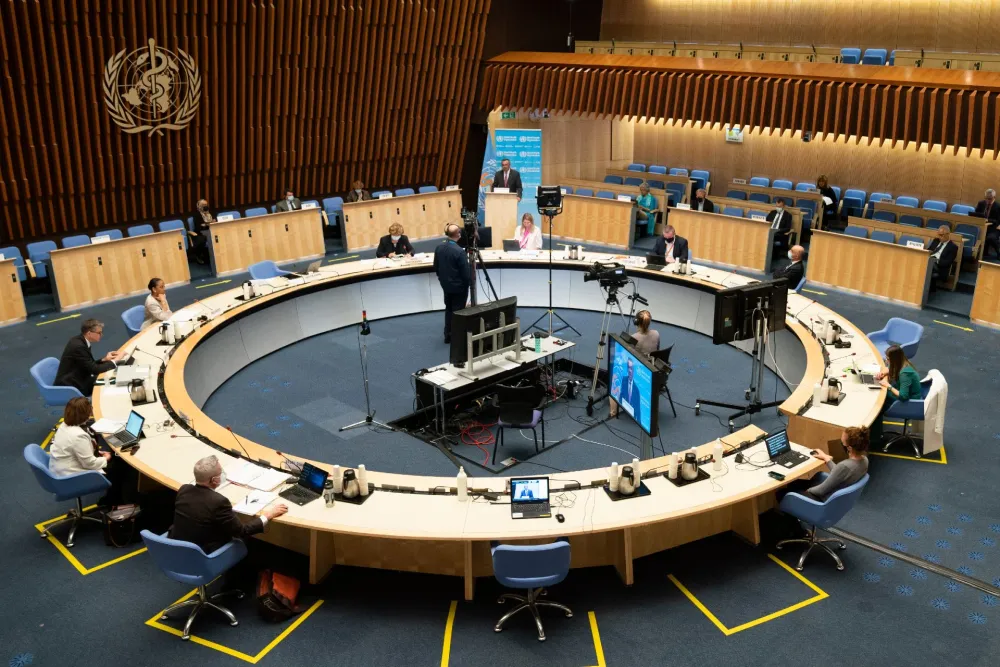
Geneva witnessed the collapse of the League of Nations in the 1930s, but it is stronger today. Not only has its institutional footprint diversified beyond the UN, its agencies, and governments, but Geneva also hosts a multitude of political spaces that offer a unique opportunity for policy innovation and cross-sectoral alliance building, including through humanitarian or faith-based movements or corporate networks that reach communities around the world. Geneva as a global hub will persist; however, in doing so it will need to proactively adapt to ensure its relevance in a changing world.
The question of how Geneva should adapt has guided the reflections of the Geneva Policy Outlook since its inception in 2022. This is why this edition draws together reflections on the pathways for adaptation while highlighting that a lot of pioneering diplomacy is taking place despite the challenging circumstances.
Adapting Multilateralism
Vinh-Kim Nguyen and Ilona Kickbusch emphasise that in this moment of crisis, institutions must embrace complexity. Multilateral diplomacy is marked by “nonlinear, chaotic, and constantly shifting dynamics” that resemble what is called ‘the three-body problem’ in modern physics and astronomy – “the impossibility of finding a general solution for trajectories of three gravitationally interacting bodies”. Translated to global health governance, climate, digital, and political challenges represent each one ‘body’ in the universe of challenges, and changes in one affect the other unpredictably. The resulting complexity demands a kind of agility that requires “constant adjustment and course correction”. Several temporary agreements might anchor a system of global health governance, but “provide no actor with dominance.” In operational terms, foresight analysis, scenario-building, and the control of narratives “will gain more importance than ever”.
Pedro Conceição proposes to reinvigorate sustainability agendas through an actionable philosophy of hope for a better future. Over decades, UN agencies have built their case on the need “to scare people of imminent catastrophe to trigger action on sustainability” – be that in relation to climate impact, digital futures, or diseases. But this approach is witnessing its limits as turning points remain elusive. The proposition is to turn the logic around and use the “aspirations for a better world for people to power a better world for all living beings while ensuring ecosystem functions”. A critical instrument in this vision will be the Nature Relationship Index that captures “the extent to which people are in good relationship with nature”.
Daniel Dobos and Prathit Singh reflect on how multilateralism could capitalise on the power of AI. Based on Apertus – “a fully open-source large language model developed by Swiss Research institutions” – Switzerland has created both the normative and operational model for AI governance that includes “transparency, neutrality, and inclusivity in its very design”. AI would become a global public good that is “designed for shared sovereignty instead of dominance”. Early trials suggest that the application of Apertus has contributed to key efficiency gains and greater linguistic and cultural inclusivity. But more important is what Apertus symbolises: “a shared digital infrastructure built on neutrality, transparency and trust … [that] could serve as a digital backbone for the international system and lay the foundation for a shared, neutral AI resource”.
“Geneva could position itself as the global capital of agenda-keeping,” argue Lucile Maertens, Zoé Cheli, Adrien Estève, and Lorenzo Guadagno. Agenda keeping is understood to mean “the process of maintaining an issue as a priority for action amid other competing problems”. At a time when several countries have shifted their positions on climate, humanitarian aid, migration, and global health, among other issues, there needs to be a hub somewhere in the world that keeps the agenda on collective challenges alive, and this hub could be Geneva. Agenda-keeping is both a distinct form of diplomacy that can help organisations navigate this period of structural transformation, as well as a “strategic tool” to assert the relevance of neglected global challenges.
Positioning Geneva as a unique global hub to broker cross-cutting and results-oriented partnerships will be critical for its adaptation.
Brokering New Partnerships
Positioning Geneva as a unique global hub to broker cross-cutting and results-oriented partnerships will be critical for its adaptation. The next section features three illustrations of such new partnerships around global food security, peace finance, and youth inclusion.
Shannon Howard sets out a new agri-food partnership for food security and humanitarian action. While Geneva is known as a major humanitarian hub, the region is also a major global trading hub, managing 22 percent of global commodities transport, especially in crude oil, grain, sugar, coffee, and cacao. Geneva could, therefore, evolve into a “unique platform to strengthen collaboration across the entire food supply chain” that would link “private sector expertise in areas such as logistic optimisation, traceability, and risk management” with experience of last-mile delivery in high-risk contexts in the humanitarian sector. The Grain and Free Trade Alliance Sustainability Pledge or the Containers of Hope Programme represent existing collaborations, but there is room for additional efforts, for instance, with respect to localised procurement or principled information exchange.
Dominique Habegger sheds light on the work of Geneva’s peace finance community. The rationale for greater partnership across impact finance and peacebuilding is clear. “While companies recognise the risks and costs of operating in fragile and conflict-affected settings, they often underestimate the reverse: the ways their activities influence or shape social or political stability. This double materiality – risks from conflict and impacts on conflict – is still a missing link in sustainable finance”. Habegger underlines an inflection point: “Conflict is systemic, portfolios are exposed, but disclosure and management lag behind”. A new conflict risk model aims to track the risk, impact, posture and exposure of companies and portfolios, and thereby “transform peace from an abstract ideal into a quantifiable material investment concern”. The model may well contribute to making conflict risk a part of standard risk disclosures.
A stronger partnership with youth for intergenerational collaboration on the challenges of our times should become a priority for the adaptation of International Geneva, argue Corinne Momal-Vanian and Prathit Singh. Geneva should go beyond tokenistic inclusion, towards an “operative international alliance of youth networks, convening in Geneva as a collective that can organise themselves as a representative and meaningful ‘youth voice’ and influence policy issues”. There is much to learn from other multilateral hubs such as Addis Ababa and the African Union’s Pan-African Youth Union, or from YOUNGO – the official children and youth constituency of the United Nations Framework Convention on Climate Change (UNFCCC). “By building an ecosystem of youth participation, International Geneva can model a more inclusive and forward-looking multilateralism”.
Diplomacy in Action
As every year, the GPO26 also highlights negotiation successes, red flags, and future opportunities that emerge from diplomatic activities in Geneva.
Daniela Morich and Gian Luca Burci reflect on the Pandemic Agreement after its adoption by the World Health Assembly on 20 May 2025. They discuss the agreement’s achievements in terms of marrying broad ambitions with the practice to prevent and manage pandemics. They also highlight the ‘prevention paradox’ whereby “decision makers hesitate to invest in preventing unpredictable and unlikely risks, despite the potentially catastrophic consequences if those risks materialise”. But the negotiation process also revealed “deep division and mistrust between the Global North and the Global South, with inflexible negotiating positions partly fed by resentment at the hoarding of COVID-19 vaccines by developed countries”. These divisions remain as the negotiations move to the Annex on pathogen access and benefit sharing (PABS), which is projected to conclude in May 2026. “Until consensus on the Annex is reached, the Pandemic Agreement cannot be opened for signature,” which leaves the agreement adopted but unfinished. Important diplomatic work lies ahead.
Ellen Rosskam and Malgorzata Alicja Stylo highlight the successes behind the global alliance to combat colourism – discrimination or prejudice based on the shade of a person’s skin tone and the associated use of skin-lightening cosmetics. The Minamata Convention on Mercury has served as a framework to work on the elimination of mercury from skin-lightening products, given the significant health risk it represents that outweighs its cosmetic effect of skin-lightening. Based on a collaboration between the United Nations Environment Programme, the World Health Organization, and other actors, as well as the leadership of Gabon, Sri Lanka, and Jamaica, important advances could be made to work towards the elimination of mercury-based skin-lightening cosmetics. These developments are a true demonstration that in the chemicals agenda, “multilateralism is thriving”.
On a less positive note, Claire Somerville raises a red flag on regressive gender policies. Multilateralism is confronted with “attempts at outright erasure of the agreed gender language in existence throughout consensus-based texts for several decades”. A key driver behind this new reality is a wave of anticipatory compliance motivated by fear of defunding after the US President rescinded the White House Gender Policy. Somerville raises the issue of erasure politics as a threat to multilateralism itself: “If a single executive order can delete ‘gender’, what else in multilateral diplomacy can be erased?” Diplomats and negotiators “must resist anticipatory compliance … Instead of quietly deleting words, they must defend them”.
The last two articles highlight opportunities for action on disarmament. By writing about “Small Weapons of Mass Destruction”, Mark Downes underlines the forward momentum in small arms control. Given the evolution in global small arms markets, there is a heightened risk of proliferation of small arms and light weapons, including man-portable air defence systems (MANPADS). These developments place a premium on data collection and analysis of illicit flows and trafficking networks, on physical security and stockpile management (PSSM), and on managing threats related to privately made firearms (PMFs) – an expert term capturing improvised weapons, ammunition, and explosives.
Luiza Delaflora Cassol and Sara Ruth Opatowski highlight the need for renewed nuclear disarmament diplomacy. “States’ rhetoric is hardening, arsenals are being expanded and modernised, and the multilateral system that served the international community so well is increasingly strained”. In February 2026, the only remaining nuclear arms control treaty between the US and Russia – the START Treaty – is set to expire. “The absence of any agreement removes the brakes on an arms race between the two nuclear powers … [and] could also have a knock-on impact on other nuclear-armed states”. 2026 will show if states can seize the moment of aggravating risks for new arms control negotiations, including through a revitalised Conference on Disarmament, which remains the single multilateral disarmament forum including three subsidiary bodies that already focus on nuclear issues.
Geneva remains an active global hub by drawing on the political energy that exists between organisations and sectors. Adapting Geneva as a global hub should strengthen its foothold in a regulatory multilateralism focused on the negotiation and administration of norms, standards, and agreements.
These examples illustrate that Geneva remains an active global hub by drawing on the political energy that exists between organisations and sectors. Adapting Geneva as a global hub should strengthen its foothold in a regulatory multilateralism focused on the negotiation and administration of norms, standards, and agreements. It should also embrace even more strongly a solution-oriented form of international cooperation by investing in scalable, cross-sector partnerships. This should include weaving a stronger bond between Geneva’s private diplomacy. “States’ rhetoric is hardening, arsenals are being expanded and modernised, and the multilateral system that served the international community so well is increasingly strained”. In February 2026, the only remaining nuclear arms control treaty between the US and Russia – the START Treaty – is set to expire. “The absence of any agreement removes the brakes on an arms race between the two nuclear powers … [and] could also have a knock-on impact on other nuclear-armed states”. 2026 will show if states can seize the moment of aggravating risks for new arms control negotiations, including through a revitalised Conference on Disarmament, which remains the single multilateral disarmament forum including three subsidiary bodies that already focus on nuclear issues.
With its long history as a global hub, Geneva has weathered many systemic shifts in the past. However, underestimating the scale of the changes now on the horizon could determine whether Geneva is marginalised or included as a global hub in a new world order. For this reason, Geneva’s adaptation should rest first and foremost on a solid understanding of how the world is changing, rather than on short-term administrative priorities. Such understanding should form the basis for sober decisions about what essence must be preserved, what is worthwhile to adapt, and what should be created entirely anew.
About the Editor
Achim Wennmann is the Editor of the Geneva Policy Outlook and has led the strategic development of this initiative as part of his functions as Director for Strategic Partnerships of the Geneva Graduate Institute. He is also a Professor in the Institute’s Interdisciplinary Programme, where he holds the Nagulendran Chair in Peace Mediation.
All publications of the Geneva Policy Outlook 2026 are personal contributions from the authors and do not necessarily reflect the views of the institutions they represent, nor the views of the Republic and State of Geneva, the City of Geneva, and Geneva Graduate Institute.